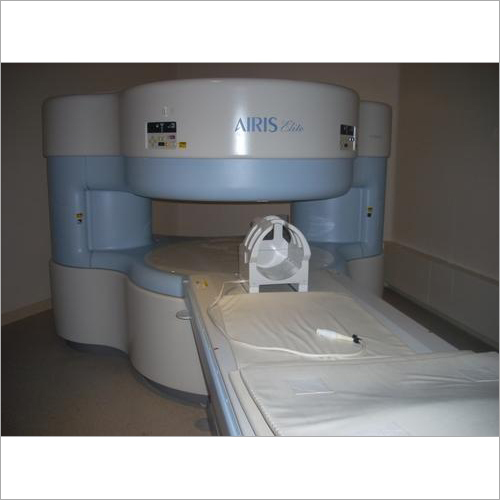
Hitachi AIRIS II Open MRI Scanner
27.00 - 29.00 INR/Set
Product Details:
- Material Metal Alloy, Medical-Grade Plastics
- Condition Refurbished / Used
- Technology Permanent Magnet MRI
- Portable No
- Disposable No
- Wall Mounted No
- Display Type External Monitor
- Click to View more
X
Hitachi AIRIS II Open MRI Scanner Price And Quantity
- 1 Set
- 27.00 - 29.00 INR/Set
Hitachi AIRIS II Open MRI Scanner Product Specifications
- External Monitor
- Hitachi AIRIS II MRI Suite, Windows PC compatible
- For Hospital and Diagnostic Imaging Center
- Approx. 7 kVA
- High Spatial Resolution (16-bit Digital)
- Electrically Operated
- Exam Room Layout Required (Open Gantry)
- No
- Magnetic Field Strength: 0.3 Tesla
- Approx. 10,000 kg
- Patient-friendly, Easy accessibility, Open MRI design
- 220-240 V AC, 50/60 Hz
- Yes
- White/Grey
- Hospital PACS System
- PC-Dependent Storage
- Refurbished / Used
- Low (Quiet Operation Magnet Design)
- DICOM, Network Ready
- Metal Alloy, Medical-Grade Plastics
- Electric
- Resistive/Inductive Coils
- No
- Permanent Magnet MRI
- No
- Head, Body, Spine, Extremity Coils
- 15 mT/m
- Spin Echo, Gradient Echo, Fast Spin Echo, Inversion Recovery
- Air Cooled
- Open, No Enclosure, Quiet Operation
- 0.3 Tesla
- Motorized, Programmable
- C-shaped Open Permanent Magnet
- Yes, Compatible with Advanced Imaging Options
- Advanced Parallel Imaging Processing
- Open No Tunnel Bore
- Up to 200 kg
- 1 Transmit, 2 Receive
- 30 T/m/s
- Special Shielded Room Needed
Hitachi AIRIS II Open MRI Scanner Trade Information
- 2 Set Per Month
- 3 Months
Product Description
Specification
Machine Condition Refurbished
Model Name/Number AIRIS II
Magnetic Strength 0.3T
Machine Type Open
Brand Hitachi
Magnet Type Permanent
Max. Amplitude 15 mT/m
Max. Slew Rate 55 T/m/s
Usage Hospital
Type Wide Bore,High-Field Open
Optional Features Whole-body integrated panoramic array
Maximum Patient Weight(Kg) 13
Options Diffusion,MRA,FSE,EPI
Coils Rapid Head,C-Spine,Rapid Body,Large Body Flex,XL Body Flex,Wrist,Shoulder,2 Extremity
Condition Excellent
RISC Based Architecture 64-Bit
Head Coil 29x22 split-top quad
Display matrix 1280 x 1024
Superior Patient Comfort and Accessibility
The open C-shaped magnet and no tunnel bore design of the Hitachi AIRIS II prioritize patient ease, reducing anxiety in claustrophobic individuals and allowing for easy setup, especially for pediatric or larger patients. The quiet operation further enhances relaxation during scans, creating a more positive imaging experience for individuals of all ages and sizes.
Advanced Imaging Performance with Versatile Modes
This MRI scanner offers multiple imaging modes including Spin Echo, Gradient Echo, Fast Spin Echo, and Inversion Recovery, supported by advanced parallel imaging processing. Its 16-bit high resolution delivers detailed visualization necessary for precise diagnostics across various anatomical regions using dedicated coils for head, spine, body, and extremities.
Easy Integration and Efficient Workflow
The AIRIS II is network ready, compatible with DICOM, and designed to synchronize seamlessly with hospital PACS systems and other devices. Its programmable, motorized patient table and Windows PC-compatible interface streamline operation, data management, and image transmission for enhanced workflow efficiency in busy clinical environments.
FAQs of Hitachi AIRIS II Open MRI Scanner:
Q: How does the open design of the Hitachi AIRIS II MRI benefit patient comfort?
A: The open, C-shaped magnet eliminates the traditional tunnel bore, minimizing feelings of claustrophobia and allowing for easier access to position patients. This design is especially beneficial for pediatric, elderly, or larger individuals and those who may be anxious about conventional closed MRI scans.Q: What imaging capabilities and modes are supported by the AIRIS II Open MRI?
A: The scanner offers Spin Echo, Gradient Echo, Fast Spin Echo, and Inversion Recovery imaging modes. It supports high-resolution imaging with advanced parallel processing, providing accurate diagnostics for head, spine, body, and extremity studies using dedicated coils.Q: When is a shielded room required for installing the AIRIS II Open MRI?
A: A special shielded room is necessary during installation to maintain magnetic safety and prevent external interference, ensuring accurate imaging and the safety of nearby electronic equipment and staff.Q: Where can the Hitachi AIRIS II Open MRI be best utilized?
A: This scanner is ideal for hospitals and diagnostic imaging centers seeking patient-friendly imaging solutions. Its accessible design and quiet operation make it suitable for facilities that treat diverse patient populations and require efficient workflow integration.Q: What is the process for performing an MRI scan with this system?
A: After positioning the patient on the motorized, programmable table, the operator selects the imaging protocol via the external monitor and PC interface. The scanner then acquires images in the selected mode, reconstructs them with parallel imaging processing, and transmits data through DICOM to PACS or other storage.Q: How does the AIRIS II Open MRI integrate with existing hospital systems?
A: It is network ready, supporting DICOM for seamless data transfer and synchronization with hospital PACS systems and other compatible devices, facilitating easy sharing and archiving of images and reports.Q: What are the main benefits for hospitals investing in the AIRIS II compared to closed MRI systems?
A: The key benefits include enhanced patient comfort due to the open, quiet design, simplified setup for various body types, lower power consumption, advanced imaging capabilities, and a user-friendly workflow that integrates easily with hospital IT infrastructure.Tell us about your requirement

Price:
Quantity
Select Unit
- 50
- 100
- 200
- 250
- 500
- 1000+
Additional detail
Mobile number
Email

Other Products in 'MRI Scanner' category



Our Location
Contact Details

- Plot no. 4, Near Metro Pillar no. 599, Milestone 15/1, Mathura Road NH2,Faridabad - 121003, Haryana, India
- Phone : 08045478895
- Mr. Deepak Roy Sharma (Director)
- Mobile :08045478895
- Send Inquiry
GST : 06AADCR7794N1ZK
 Send Inquiry
 Send Inquiry
 Send SMS
 Call Me Free
RADIMAGE TECHNOLOGIES PVT. LTD.
All Rights Reserved.(Terms of Use)
Developed and Managed by Infocom Network Private Limited.
Developed and Managed by Infocom Network Private Limited.

